CodeFusionAI
Collaborative coding with isolated execution and realtime sync.
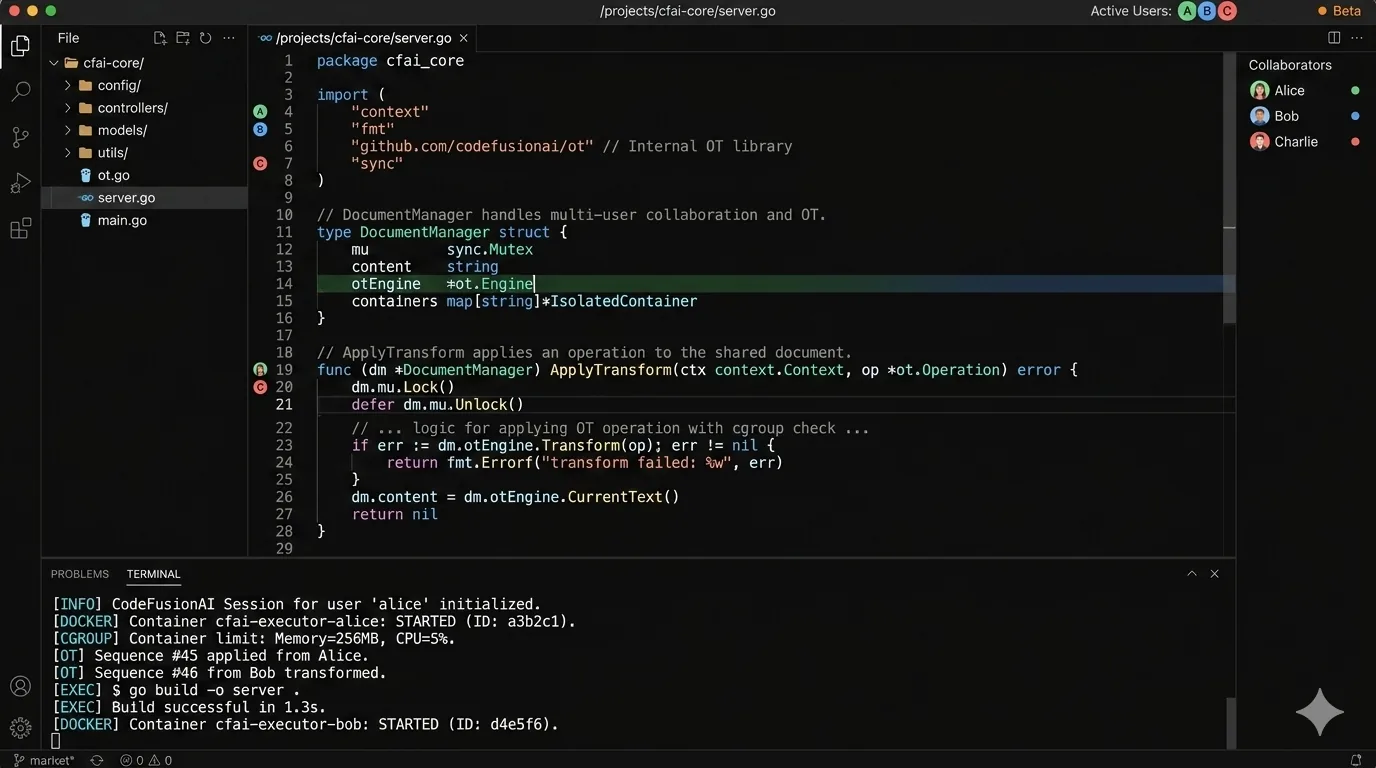
Overview
CodeFusionAI is a collaborative coding environment combining shared editing workflows, realtime synchronization, isolated execution containers, and multi-user presence systems.
The project explores how collaborative editing and shared execution can coexist without tightly coupling transport, presence, and runtime systems.
Problem
Collaborative editors become difficult to maintain once synchronization, execution isolation, and realtime presence all interact simultaneously.
Many systems either overcomplicate operational transforms or tightly couple cursor traffic with document synchronization.
The goal was to build a simpler architecture focused on correctness and predictable behavior.
Architecture
Backend systems are written in Go with isolated Docker execution environments and cgroup-limited runtime sandboxes.
Realtime coordination uses WebSockets with separate transport channels for document synchronization and presence traffic.
Frontend systems are built with React and shared multi-user editor workflows.
Document
- EditorReact
- OT layerGo; small and well tested
- Shared documentOne converged state
Presence
- Cursors and selectionsHigh-frequency, disposable
- Separate WebSocket channelNever queued behind edits
Execution
- Run requestFrom the session
- Docker containerOne per session
- cgroup limitsCPU and memory bounded
Tradeoffs
The project intentionally favors operational correctness over aggressive feature expansion.
Certain IDE-style capabilities and advanced collaboration layers were intentionally not built to keep synchronization behavior understandable and maintainable.
- Sandboxed
- Execution
- OT layer
- Sync
- Split
- Channels
What I'd do differently
The project improved understanding of OT systems, synchronization boundaries, isolated execution environments, realtime transport separation, and collaborative runtime coordination.
It also reinforced how quickly complexity grows when shared execution and shared editing interact.